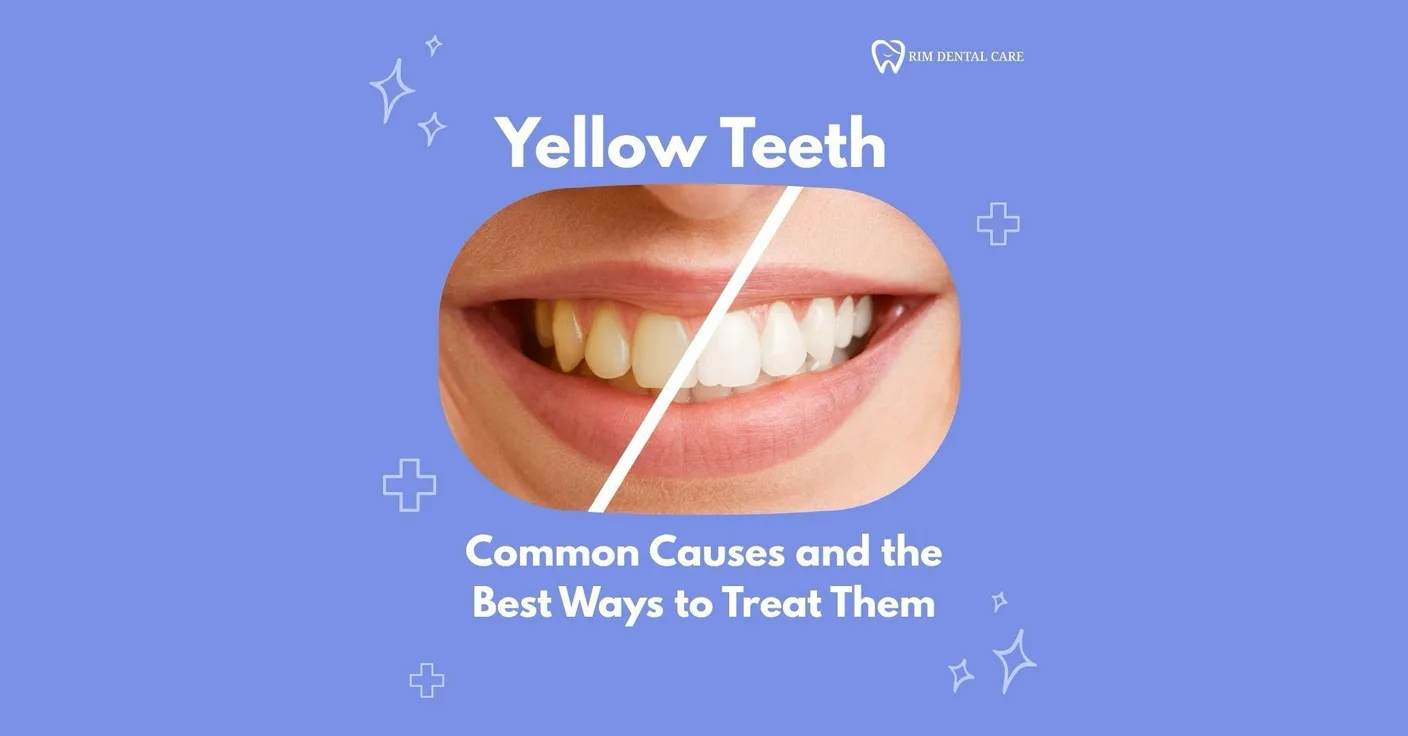
Yellow teeth are one of the most common things patients bring up at The Rim Dental Care — usually with the same question: "I brush every day, so why are my teeth still yellow?" The honest answer is that yellowing has several different causes, and they don't all respond to the same treatment. Whitening strips can erase years of coffee stains and do almost nothing for yellowing that comes from inside the tooth. This guide walks through what actually causes discoloration, how to tell which type you have, and what works on each.
Deeply pigmented foods and drinks are the most common source of yellowing. Coffee, black and green tea, red wine, cola and dark sodas, tomato-based sauces, curry, and berries all leave color behind on enamel. Many of them are also acidic, which softens the enamel surface for a while after you drink them and lets pigment settle in more easily. Our companion guide covers this in detail: foods that stain your teeth (and how to prevent it).
Tar and nicotine are exceptionally good at sticking to tooth structure, which is why smokers and chewing-tobacco users usually see yellowing — then browning — far faster than non-smokers. Tobacco stains also tend to settle along the gumline and between teeth, where a toothbrush has the least reach. Quitting stops new staining, and a professional cleaning plus whitening can reverse a great deal of what's already there.
Plaque that isn't removed daily hardens into tartar within a couple of days, and tartar is porous, yellow-brown, and impossible to brush off. What looks like "yellow teeth" is often a layer of tartar sitting on top of perfectly white enamel. This is the most satisfying cause to fix — a professional cleaning frequently gets teeth several shades lighter before any whitening is even discussed.
Tetracycline and doxycycline taken during childhood tooth development can cause permanent gray-brown banding. Some antihistamines, blood pressure medications, and antipsychotics are associated with discoloration, as are excess fluoride during development (fluorosis), chemotherapy and head-or-neck radiation, and trauma to a single tooth — an injured tooth can darken on its own years later.
Enamel is translucent; the dentin underneath it is naturally yellow. Some people are simply born with thinner or more translucent enamel and more deeply colored dentin. Everyone's enamel also thins with age and wear, so more of that yellow dentin shows through over time. This is normal, not a hygiene failure — and it's one of the cases where whitening makes a dramatic difference.
Nearly every case of yellowing falls into one of two categories, and telling them apart is the single most useful thing you can do before spending money on whitening.
| Extrinsic (surface) | Intrinsic (internal) | |
|---|---|---|
| Where it sits | On the outside of the enamel | Within the dentin, under the enamel |
| Typical causes | Coffee, tea, wine, tobacco, tartar buildup | Aging, genetics, tetracycline, fluorosis, trauma, root canal |
| Look | Yellow-brown film, worse at the gumline and between teeth | Even yellow-gray tone, or one darker tooth, or horizontal bands |
| What works | Cleaning, whitening toothpaste, strips, in-office whitening | Professional whitening (slower), internal bleaching, veneers or bonding |
A quick rule of thumb: stains that appeared gradually in adulthood and look worse near the gums are usually extrinsic. A uniform yellow-gray tone you've had as long as you can remember, or one single dark tooth, is usually intrinsic. For a neutral overview of how whitening works chemically, the American Dental Association's patient guide to whitening is a good reference.
Whitening gel can't bleach through tartar, and applying it over buildup gives you patchy results. A cleaning removes the hardened deposits and surface film first, so any whitening that follows lands evenly on actual enamel. For many patients with purely extrinsic staining, the cleaning alone is enough.
In-office teeth whitening uses a much higher concentration of peroxide than anything sold over the counter, with your gums and soft tissue isolated so the gel can work safely at that strength. It typically lifts several shades in a single appointment, and it's the most effective option for stubborn extrinsic staining and mild-to-moderate intrinsic yellowing.
Custom trays are made from impressions of your own teeth, so the gel stays on the enamel instead of leaking onto your gums — the main reason drugstore trays cause sensitivity and uneven results. You wear them on a schedule we set, usually over one to two weeks. Take-home trays are also the best way to maintain in-office results with an occasional touch-up.
Whitening toothpastes are mildly abrasive and remove fresh surface film; they don't change the color of your enamel. Strips can genuinely lighten mild extrinsic staining. Neither one touches intrinsic discoloration, and neither will lighten crowns, veneers, bonding, or fillings — which is why a heavily restored front tooth can end up looking darker than everything around it after whitening. Avoid charcoal pastes and DIY baking-soda-and-acid scrubs; they abrade enamel, and thinner enamel means a more yellow tooth long term.
Tetracycline banding, deep fluorosis, and a single tooth darkened by trauma or a root canal often don't respond well to external bleaching. Those cases are usually solved with internal bleaching of the affected tooth, or by covering the surface with porcelain veneers or conservative composite bonding. If existing crowns or fillings are the mismatched part, replacing them after whitening is what gets the shade to match.
Book an exam if home care isn't improving the color, if a single tooth is darkening (that often signals a dying nerve, not a stain), or if yellowing comes with sensitivity, pain, or bleeding gums — those point to enamel erosion or gum disease rather than cosmetic staining, and whitening on top of either makes things worse.
Not sure whether your yellowing is on the surface or inside the tooth? That's a five-minute answer at an exam. Call The Rim Dental Care at (726) 215-9920 or book an appointment — we'll tell you which type you have and exactly what it would take to fix it, with the price in writing before anything starts.
Two different things: stains that build up on the enamel surface from coffee, tea, wine, tobacco, and tartar, and discoloration from inside the tooth caused by aging, genetics, certain medications, fluorosis, or injury. Poor hygiene makes surface staining worse and faster.
Surface (extrinsic) stains sit on the outside of the enamel and usually lift with a cleaning or whitening. Internal (intrinsic) discoloration is in the dentin under the enamel and doesn't respond the same way — it needs professional whitening, internal bleaching, or veneers. A dentist can tell you which you have in a single visit.
You can improve mild surface staining: brush twice a day, floss nightly, use a whitening toothpaste or strips as directed, rinse after pigmented drinks, and cut back on coffee, tea, soda, and red wine. Home care won't change internal discoloration and won't remove hardened tartar.
Professionally supervised whitening at proper concentrations doesn't damage enamel. Temporary sensitivity is common and fades within a day or two. What does cause damage is abrasive DIY whitening — charcoal pastes, baking soda plus lemon or vinegar — which permanently wears enamel down and eventually makes teeth look more yellow.
No. Whitening gel only changes natural tooth structure. Dental work stays exactly the shade it was made, so restorations on visible teeth may need to be replaced after whitening to match your new shade.
Typically one to three years, depending on diet and whether you use tobacco. Occasional touch-ups with custom take-home trays keep the shade stable far longer than repeating a full treatment.
If home care hasn't helped, if one tooth is darkening on its own, or if the yellowing comes with pain, sensitivity, or bleeding gums. Those symptoms suggest erosion, decay, or gum disease — problems that need treatment before any cosmetic whitening.
Tell us a little about what you need — we'll be in touch shortly.
6028 WORTH PKWY STE 101, SAN ANTONIO, TX 78257-5071, United States
Hi! I'm Tooth fairy! Your AI Assistant Ask me anything